
Serial Casting is a technique to stretch muscles over a period of time by using a cast. At Savannah Speech & Hearing Center, our physical therapy team is now offering this treatment to address tightness in the legs. A cast will be applied to the leg for 1 week at a time. The cast is then removed and re-applied if necessary. In some cases, this is a great alternative to surgical interventions.
I have 7 years of experience with serial casting and I’m thrilled to expand opportunities for our Savannah community to benefit from this therapeutic strategy!
Who can benefit from this?

Children with tendencies or diagnoses listed here:
- Toe walking
- Cerebral Palsy
- Neuromuscular Diagnoses (including Spinal Muscular Atrophy, Duchenne Muscular Dystrophy, Charcot Marie Tooth)
- Cancer diagnoses (it is common to see ankle weakness and tightness with certain chemotherapy medications)
- Stroke
If you notice toe walking, difficulty fitting in braces or in pulling the toes up – serial casting may be a good consideration.
What is the process
A physical therapist will use specialized materials when casting. This will include padding to protect the skin, casting material, and walking boots. Eight weeks of physical therapy will be scheduled to complete an evaluation and weekly cast changes. Depending on your child’s tolerance and diagnosis, this could take shorter or longer.
Conventional physical therapy is often recommended once serial casting is completed for the best results.
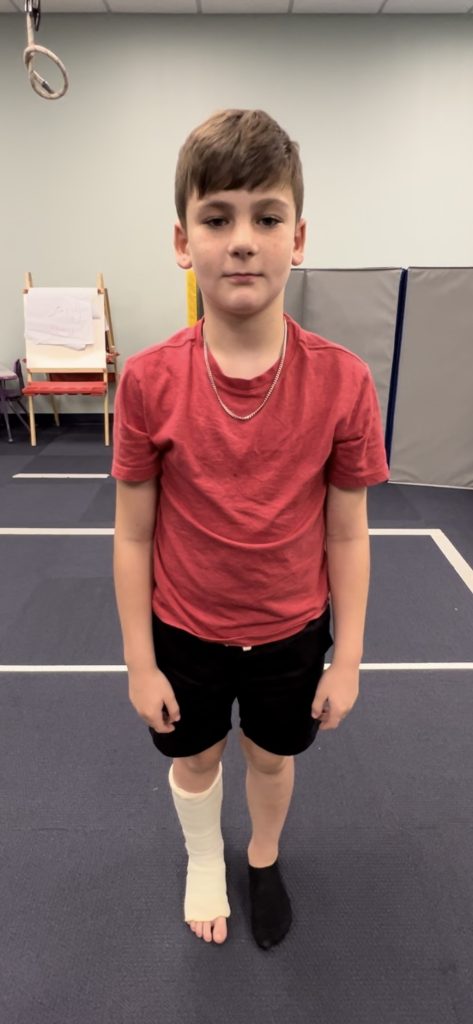
Since the goal of serial casting is to improve range of motion, this is an active process! In fact, we encourage standing and moving as frequently as possible. This will help gain range of motion. If you were able to walk without support, this is what we expect with the casts on. If you were able to stand in a stander or walk with a device, we continue to encourage you to do this. The restrictions that we do recommend are as followed:
- Do not put anything inside the cast
- No running/jumping
- Keeping the casts dry
- Walking boots for safety and positioning
What are the risks?
While this is a conservative treatment, there are risks that come along with this process. Skin irritation is the main risk. Since we are placing your child in a cast, they will be at risk for blisters or rubbing of the cast. While cautionary measures are taken to limit any skin irritation, it can still occur. You and your child will be provided with positional techniques and further education to address this barrier. Since the cast is removed weekly, we will monitor the skin once a week. Your therapist may recommend skipping a week if they notice any concerns regarding their skin.
Let us know below if you have general questions! For medical advice and interest, please contact our office and schedule a PT evaluation by calling 912.355.4601 or 912.214.3156 for Spanish.

Leave a Reply