To honor World Down Syndrome Day, this blog will discuss gross motor skills with Down Syndrome. Down syndrome (DS) is the most common chromosomal abnormality where three copies of Chromosome 21 (Trisomy 21) are present. About 1/700 babies in the United States are born with DS. Individuals with DS tend to have common physical characteristics, developmental concerns, and health concerns.
One of the common features with DS is developmental concerns. The good news is there are studies that showed us that almost all children with DS achieved gross motor skills that are typically expected in childhood! This includes walking, running, and jumping. However, we also know that it can take almost 2 times the typical range to achieve a milestone. This is often attributed to a few common characteristics such as:
Low tone
Laxity
Decreased muscle strength
Decreased postural control due to smaller cerebellum (in the brain)
Medical complexity (including surgery and hospital stays at a young age)
A study completed by Palisano and colleagues, created a gross motor curve for children with Down syndrome from 1 month to 6 years. This is similar to the growth curves that are provided at the Pediatrician for height and weight. Instead, this gives us a curve based on age and gross motor skill ability. While this gives us great guidelines to guide gross motor development, we also know that each child is unique and will achieve skills differently. Even in typically developing peers, this timeline is provided in a range. Below is a table that summarizes the gross motor curve found by Palisano:
This can be divided into floor skills and standing skills. Floor skills (rolling, sitting, crawling) are typically the focus until 18 months. After 18 months, most children with DS are working on standing based skills. This study also noted that while new skills can be achieved, the quality of movement is typically different. Therefore, increased time and repetition are expected when learning more challenging skills. This is where physical therapy can make a difference.
Freebies
What can I get started on to help my child? A few interventions that are shown to accelerate gross motor skills with children with Down Syndrome are the following:
Tummy time (read our tummy time suggestions here) This has shown to be effective at a very young age, but talk with your doctor to ensure that your child doesn’t have any precautions (certain precautions are set after surgery).
Wentz and colleagues listed a variation of tummy time techniques in the 2017 article, “Importance of Initiating a “Tummy Time” Intervention Early in Infants with Down Syndrome.”
Treadmill training: Treadmill training can start as early as learning to sit independently. While protocols vary, improvements were noted with only 6 minutes per day at about 0.5 mph.
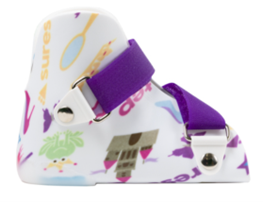
Foot Orthotics: This can impact your child’s walking pattern and improve overall alignment.
Surestep SMO is one example of a foot orthotic.
*A PT can further instruct you on handling techniques, the best orthotic to support your child’s development, and variations to modify or progress each program.
Gross motor skill level is positively related to cognition level. Therefore, we want our kids to meet gross motor skills as close to the anticipated timeline as possible.
Early physical therapy has shown the best outcomes. In fact, starting PT before the 1st birthday and tummy time prior to 11 weeks with DS is safe and has shown accelerated outcomes!
Let’s rock our fun socks on March 21st to bring awareness to Down Syndrome! What PT questions or comments do you have about this population?
References
Palisano RJ, Walter SD, Russell DJ, et al. Gross motor function of children with Down Syndrome: creation of motor growth curves. Arch Phys Med Rehabil. 2001; 82 (4): 495-500
Wentz EE. Importance of Initiating a “Tummy Time” Intervention Early in Infants With Down Syndrome. Pediatr Phys Ther. 2017 Jan;29(1):68-75. doi: 10.1097/PEP.0000000000000335. PMID: 27984474.
Ulrich, DA, Ulrich BD, Ulrich DA, Angulo-Barroso RM. Exploring effects of different treadmill interventions on walking onset and gait pattern in infants with Down Syndrome: Evidence Based Developmental outcomes. Dev Med Child Neurol. 2001; 108(5):e84
Veldman SLC, Santos R, Jones RA, Sousa-Sá E, Okely AD. Associations between gross motor skills and cognitive development in toddlers. Early Hum Dev. 2019 May;132:39-44. doi: 10.1016/j.earlhumdev.2019.04.005. Epub 2019 Apr 6. PMID: 30965194.
Martin K. Effects of supramalleolar orthoses on postural stability in children with Down syndrome. Dev Med Child Neurol. 2004 Jun;46(6):406-11. doi: 10.1017/s0012162204000659. PMID: 15174532.
Arslan FN, Dogan DG, Canaloglu SK, Baysal SG, Buyukavci R, Buyukavci MA. Effects of early physical therapy on motor development in children with Down syndrome. North Clin Istanb. 2022 Apr 18;9(2):156-161. doi: 10.14744/nci.2020.90001. PMID: 35582517; PMCID: PMC9039636.
Member of our Rehabilitation team, Pamela Thompson, M.Ed., CCC-SLP encourages families of children with Down…
Jennifer Jones PT DPT PCS
Jennifer Jones PT, DPT, PCS (Pediatric Physical Therapist and Board-Certified Pediatric Clinical Specialist) obtained her Doctorate of Physical Therapy from Shenandoah University and has spent the past 7 years as a pediatric physical therapist working at The Children’s Hospital of Philadelphia (CHOP), where she was a primary therapist in Neuromuscular Clinic and a Clinical Evaluator for the Duchenne Muscular Dystrophy trials. She has earned her Board-Certified Pediatric Clinical Specialist designation and is experienced in acute and inpatient rehabilitation. Dr. Jones is very passionate about working with the Neuromuscular population and has had the opportunity to assist with teaching at local physical therapy schools and through the Muscular Dystrophy Association. She also enjoys working with developmental, orthopedic, oncology, and post-concussion diagnoses. Dr. Jones is now accepting clients at our Savannah center.
Follow Jennifer Jones PT DPT PCS:
About Jennifer Jones PT DPT PCS
Jennifer Jones PT, DPT, PCS
Savannah Speech & Hearing Center





Leave a Reply