
After chatting with a coworker recently, I realized that I’ve somehow entered the era of parenting school-age children. It hit me that I’m no longer in the baby and toddler stage. As I reflected, I was reminded that every stage is a season.
Even though my own children have grown, I still deeply empathize with parents navigating the postpartum months. That season of life was transformative for me both personally and professionally. It’s one reason I’m passionate about offering programs like Tummy Time Champions and other classes designed to support families during the first year. I also remember the exhaustion that comes with caring for a newborn. That’s why I wanted to write about safe sleep and tummy time. I frequently hear questions about head shape, torticollis, sleep positioning, and developmental milestones.
Before diving into a few questions, the American Academy of Pediatrics and NIH use the ABC’s of Safe Sleep. This is a great established and evidenced based mnemonic to remember:
A – Alone
- No pillows
- No blankets
- No stuffed animals
- No crib bumpers
B- On Their Back
- Every Sleep
C- In a Crib
- Firm flat surface
- No inclined sleeps
- Tight fitting mattress
Below are answers to some of the most common safe sleep questions I receive as a pediatric physical therapist. While this blog focuses on positioning, tummy time, and head shape, you can find additional evidence based safe sleep guidelines on NIH Safe to Sleep website. Two recommendations that I found surprising as a new parent was that offering a pacifier at sleep and feeding human milk are both associated with a reduced risk of sleep related infant deaths.
Question 1 – Won’t sleeping on my back cause increased head flatness?
This is one of the most common concerns I hear. The answer is that babies should still sleep on their backs, even if they have a flat spot. The solution is not changing the sleep position – it’s increasing supervised awake positioning.
Here are a few strategies to help during wake windows:
- Daily tummy time
- Alternating how you hold and carry your baby
- Encouraging head turning to both sides
- Encourage firm surfaces when baby is lying on their back
Question 2 – What about those plagiocephaly pillows I can buy online? Won’t that help my baby’s head shape?
While a special pillow sounds like the perfect fix to help reshape a baby’s head, current research has not demonstrated that these products effectively improve head shape, and they are not recommended for use during sleep.
Instead, focus on strategies that are both developmentally beneficial and safe:
- Increase supervised tummy time throughout the day
- Incorporate sidelying play to redistribute pressure across the skull
- Address torticollis early if you notice a head turning preference
- Encourage floor play
Savannah Speech and Hearing Center offers a Torticollis Clinic if you have any concerns. We also have a Torticollis blog for you
Question 3 – What about swaddles?
Swaddling can help some babies settle, but there are some important safety considerations.
- Stop swaddling as soon as baby shows signs of rolling
- Monitor for overheating
Swaddling should stop as soon as your baby is showing signs of rolling. Rolling is often expected around 4-6 months, but you may notice signs prior to this as soon as 3 months.
Question 4 – My baby hates tummy time. What should I do?
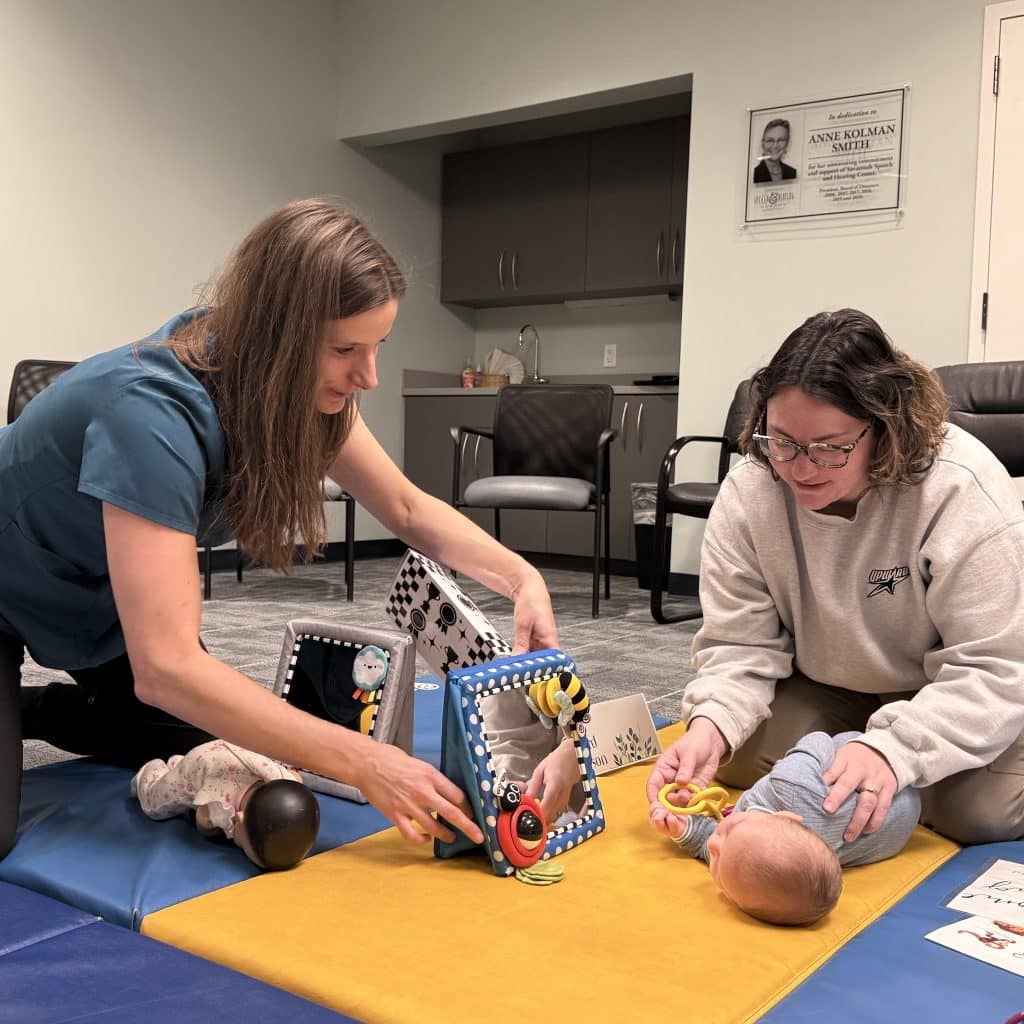
Many babies dislike tummy time at first. It is hard and requires practice! Tummy time is a skill that develops over time, not something babies automatically enjoy.
Try:
- Short, frequent sessions throughout the day
- Chest to chest tummy time
- Tummy time in your lap
- Getting down on the floor face to face with your baby
Remember that tummy time happens when your baby is awake and supervised. Sleep time and tummy time serve different purposes and both are important for healthy development.

It is common to struggle with tummy time. For additional guidance on tummy time, we have a Tummy Time Blog for you. We’d also love to see you at Tummy Time Champions if you are local to Savannah, GA to learn what techniques work best for you.
The newborn stage can feel overwhelming, but you are already doing a great job. Safe sleep and strong development aren’t competing goals, they work together. By following safe sleep recommendations and making the most of your baby’s awake time, you’re giving them a strong start. You can do this!
Have questions about tummy time, torticollis, head shape, or infant development? Contact Savannah Speech & Hearing Center to learn how pediatric physical therapy can support your baby’s growth while keeping safe sleep a priority.
Resources
Moon RY, Carlin RF, Hand I; TASK FORCE ON SUDDEN INFANT DEATH SYNDROME AND THE COMMITTEE ON FETUS AND NEWBORN. Sleep-Related Infant Deaths: Updated 2022 Recommendations for Reducing Infant Deaths in the Sleep Environment. Pediatrics. 2022 Jul 1;150(1):e2022057990. doi: 10.1542/peds.2022-057990. PMID: 35726558.

Leave a Reply